Exploring the Maya Archaeological Sites Near Maya Ka’an
Maya Ka’an is the quiet side of the Mexican Caribbean: jungle, wetlands and Maya communities where daily life still follows its own rhythm. It is also a good base for anyone curious about the ancient Maya, because some of the region’s most rewarding archaeological sites sit within Maya Ka’an or a short drive from it. Here are four worth planning a day around.
1. Muyil: gateway to the ancient trade routes
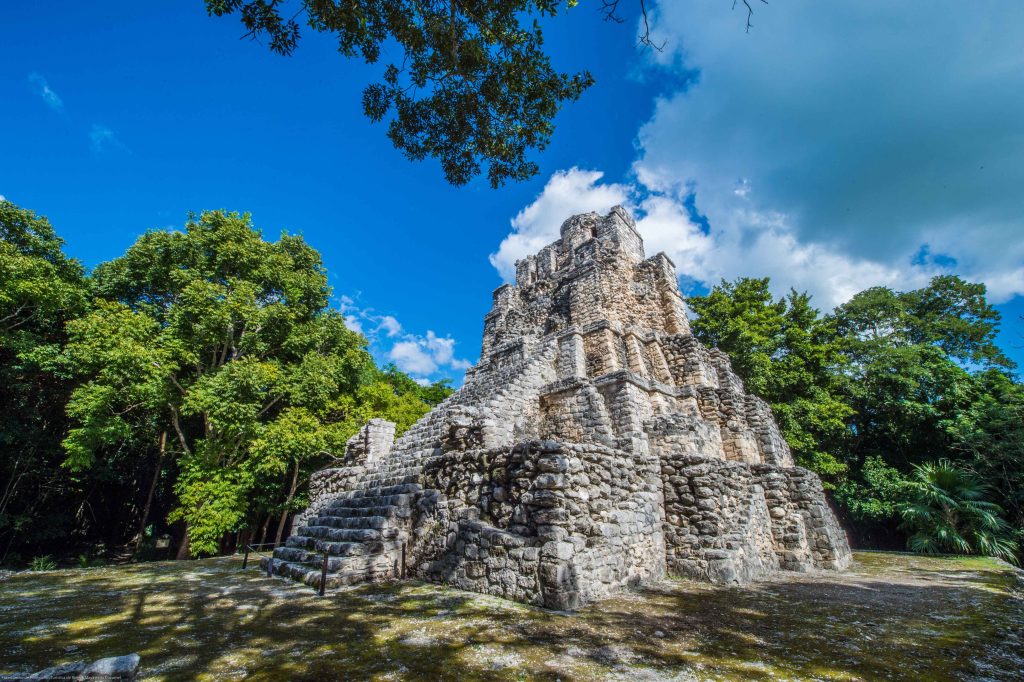
Muyil, also known as Chunyaxché, stands at the gateway to the Sian Ka’an Biosphere Reserve, in the municipality of Felipe Carrillo Puerto. It is one of the oldest Maya settlements on this coast, and it grew on trade: goods moved between the inland cities and the sea through the lagoons and the canals the Maya cut across the wetlands.
The main building is El Castillo, a pyramid that rises above the treetops. The site is compact and shaded, and the jungle presses in close enough to give you a feel for what the city was like when people lived here. Once you have walked the ruins, the classic add-on is a boat trip on the lagoon behind the site, floating down the same canals the Maya used to carry their goods to the coast. A local Maya cooperative runs the tours.
2. Tulum: the walled city by the sea
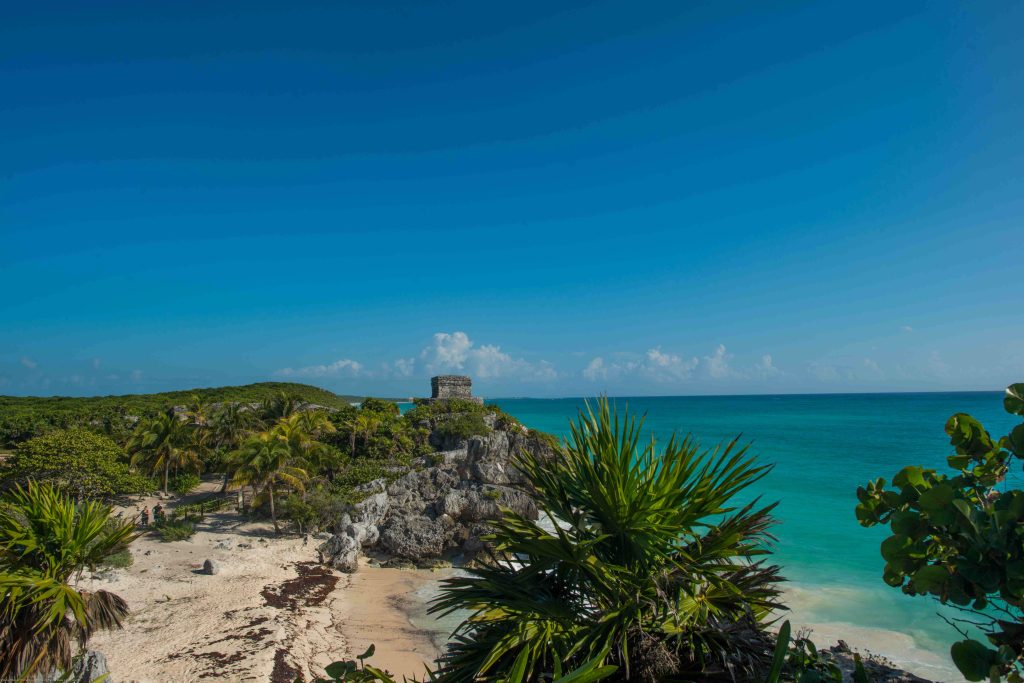
Tulum is a destination in its own right rather than part of Maya Ka’an, but it sits next door and it would be a shame to skip it. The walled city stands on a cliff above the Caribbean, which makes it one of the most photogenic Maya sites in Mexico.
It reached its peak in the Late Postclassic period (roughly 1200 to 1521), when it was a busy trading port: canoes came in through a small cove below the cliffs. El Castillo, the pyramid on the edge of the cliff, is the building everyone recognizes from the photos. Walk the well-preserved temples and you get a clear picture of the town’s part in the coastal trade and in its own defence, since the wall on the landward side still stands. Access to the beach below the ruins is not always open, so ask at the entrance whether you can go down for a swim.
3. Cobá: a city in the jungle
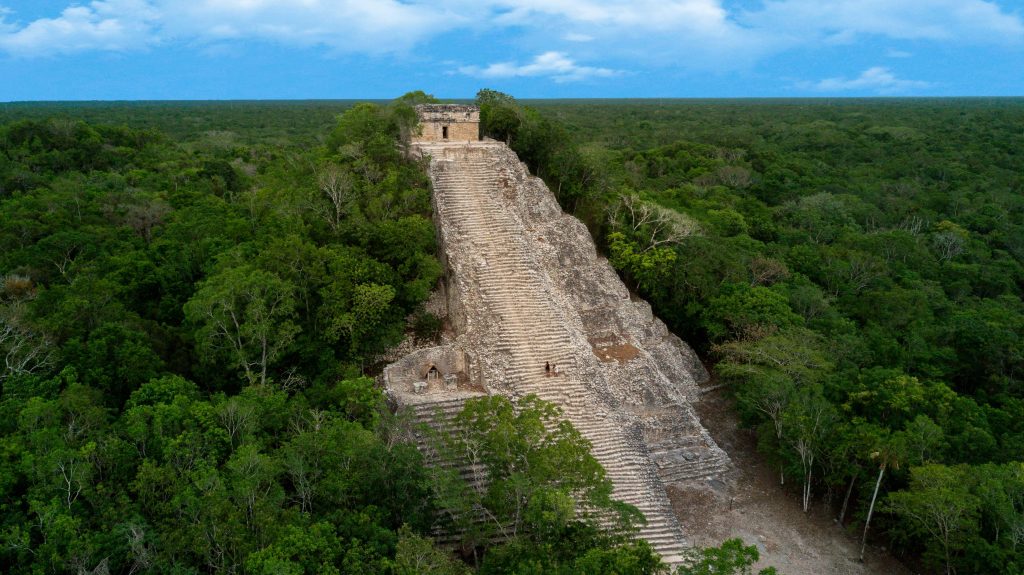
Cobá lies inland, deep in the jungle, and it is one of the largest Maya sites in the region. At its height it was a powerful city of tens of thousands of people and the hub of a vast network of sacbeob, the raised white roads that linked Maya cities.
Its landmark is Nohoch Mul, which at 42 metres (138 feet) is the tallest pyramid in the northern Yucatán Peninsula. Climbing it was banned in 2020, but in December 2025 INAH reopened the ascent with a protective wooden staircase laid over the original 120 stone steps, so you can once again go up and look out over the canopy. Cobá also has ball courts, stelae (carved stone monuments) and a scatter of smaller temples, a good introduction to how the ancient Maya lived and worshipped.
4. Kohunlich: the Temple of the Masks
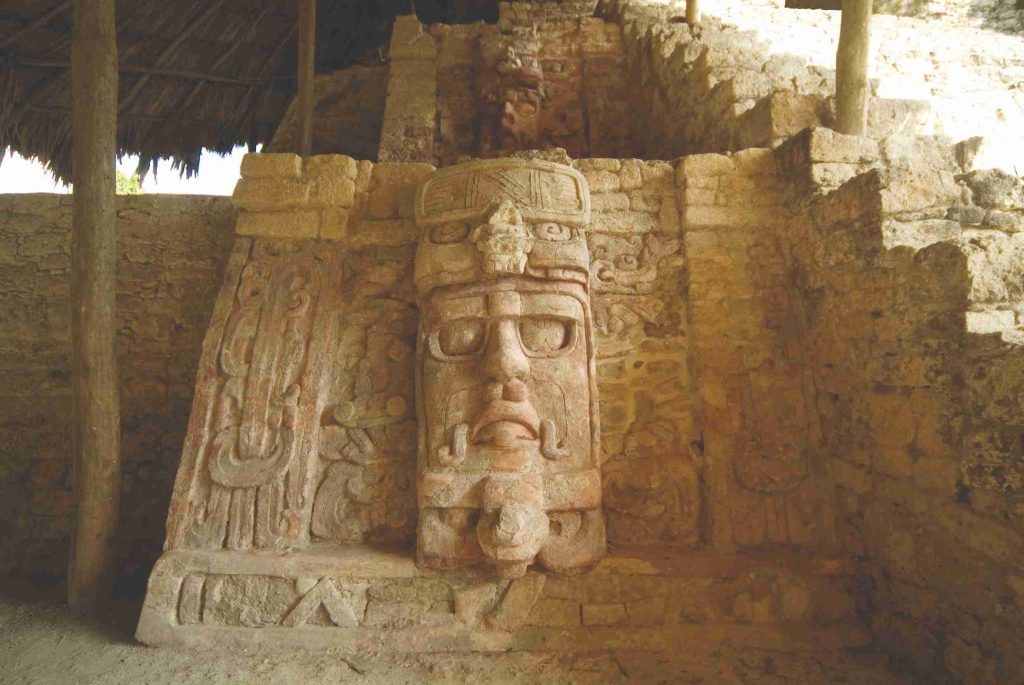
Kohunlich is a long way south, about 65 km west of Chetumal, so it is not a day trip from Maya Ka’an. Anyone touring the southern Mexican Caribbean should see it all the same. Its fame rests on the Temple of the Masks, an Early Classic pyramid whose central stairway is flanked by large stucco masks associated with the sun god Kinich Ahau, remarkably well preserved because a later building was raised over them.
Beyond the temple there are plazas, residential compounds and smaller temples set among the trees, and far fewer visitors than at Tulum or Cobá. It is the calm end of any Maya itinerary in the region.
Maya Ka’an is more than jungle and lagoons. It is a region with a long memory, and its archaeological sites are among the least crowded in the Mexican Caribbean. From the canals of Muyil to the top of Nohoch Mul, each one shows a different side of the civilization that shaped this coast. If you want to get closer to the Maya world than a tour bus allows, this is the place to start.
Join us on Instagram for travel inspiration and the best of the Mexican Caribbean. Follow us ✨

